
Albany County Death Records
Albany County death records date back to 1848, which makes them some of the oldest vital records in New York State. The county seat is the state capital, and that gives residents a unique edge when it comes to searching for death certificates. You can reach the NYS Department of Health, the State Archives, and the local registrar all within a few miles of each other. Albany County has about 314,000 residents and sits at the heart of the Capital District. If you need a death record from this county, there are several paths you can take depending on when the death took place and what type of copy you need.
Albany County Quick Facts
Where Albany County Death Records Are Kept
Albany County death records are not held by the County Clerk. That surprises a lot of people. The Albany County Clerk at 16 Eagle Street keeps deeds, mortgages, divorce records, and Supreme Court records from after 1919. But for death certificates, you need to go somewhere else. Birth and death records must be obtained from the New York State Department of Health or from the city, town, or village clerk where the death took place. The Albany County Clerk's office at (518) 487-5100 can point you in the right direction if you call, but they cannot pull a death certificate for you.
For deaths that happened in the City of Albany, the local registrar handles the filing. Town clerks across Albany County each keep their own set of records too. The towns of Bethlehem, Colonie, and Guilderland all have clerk offices that maintain death records for events in their borders. If you know the town where someone died, start there. It is usually faster than going through the state.
Pre-1914 Albany Death Records
This is the part that trips up most people. Albany is one of only three cities in New York where the state health department does not have vital records from before January 1, 1914. The other two cities are Buffalo and Yonkers. The New York Genealogical and Biographical Society has detailed guidance on this issue. If you need an Albany County death record from before 1914, you must contact the City of Albany directly.
The Albany Local Registrar keeps pre-1914 death records at Room 254M, City Hall, Albany, NY 12207. These records go back to 1848 for deaths and 1870 for some other vital records. The City Clerk at Room 202 in the same building handles marriage records from that same era. This split between the local registrar and the state is a big deal for genealogy researchers. Many people write to the state and get told there is no record on file, when the record actually exists at City Hall. Albany death records from 1848 through 1913 are only at the local level. The state never got copies of them.
After 1914, Albany County death records are in the state system. You can order those from the NYS Department of Health or from the local clerk.
Ordering Albany County Death Certificates
The NYS Department of Health handles death certificate orders for records from 1914 forward. Mail orders cost $30 per copy. Online and phone orders run $45 plus a vendor processing fee. You mail forms to the Vital Records Certification Unit at P.O. Box 2602, Albany, NY 12220-2602. The toll-free number is (855) 322-1022. The state is currently dealing with big delays on processing, so plan ahead if you can.
For genealogy research, the rules are a bit different. Death records that are at least 50 years old can be requested as uncertified genealogy copies. The NYS DOH genealogy page explains the fee tiers. A basic search covering one to three years costs $22. Wider searches cost more. A 41 to 50 year search runs $122. Processing can take eight months or longer for genealogy requests. That is not a typo. The backlog is real.
You can also drop off genealogy applications at the New York State Archives on the 11th floor of the Cultural Education Center at 222 Madison Avenue in Albany. Staff will send your form to the processing center by interagency mail. The archives also have microfiche indexes to deaths from 1880 through 1943 that are free to search in person. These indexes do not cover New York City deaths.
Albany County Death Records and the State Archives
The New York State Archives sit right in Albany County, which is a huge benefit for local researchers. The archives hold microfiche indexes for statewide death records from 1880 to 1943. You can visit during their hours, Monday through Saturday from 9:30 AM to 5:00 PM, and search these indexes at no cost. The address is the Cultural Education Center at 222 Madison Avenue, Albany, NY 12230. Call (518) 474-8955 for more details.
Once you find a record in the index, you can fill out an application right there and drop it off. The archives will forward it to the Department of Health for processing. This saves you the step of mailing it yourself, though the processing time is still the same. For Albany County death records specifically, remember that pre-1914 deaths in the City of Albany will not show up in the state indexes. Those records were never sent to the state.
Who Can Get an Albany Death Certificate
New York law limits who can get a certified copy of a death certificate. The spouse, parent, child, or sibling of the person who died can request one. Other people need to show a documented lawful right or claim, a documented medical need, or a New York State Court Order. For example, if you need a death certificate to process an insurance claim, you would need a letter from the insurance company explaining why you need it.
You must submit a valid photo ID with your application. A driver's license, state ID, passport, or military ID all work. If you do not have photo ID, you can send two documents that show your name and address, like a utility bill and a letter from a government agency dated in the last six months. Foreign applicants have to include a copy of their U.S. passport on top of the other ID.
Note: Applications without proper ID are one of the most common reasons for denial according to the NYS Department of Health.
Albany County Death Records and Surrogate's Court
When someone dies in Albany County, their estate often goes through the Surrogate's Court. This court handles wills, probate, and estate administration. Probate records can be a useful back door for finding death information, since the court file typically lists the date of death, names of family members, and other details. You can search estate records online through WebSurrogate, a free tool run by the New York State court system. It covers filings across all 62 counties.
Albany County Surrogate's Court records go back to the 1680s, which makes sense given that Albany is one of the original counties formed in 1683. These older records can fill in gaps where death certificates do not exist. A certified death certificate is required to open a probate case, so the court file itself confirms that a death record was issued at some point.
Since Albany County has no images in the local screenshot manifest, here is a view of the statewide resource most Albany County residents use to start their search. The NYS Department of Health death certificate page is the main portal for ordering records by mail or online.
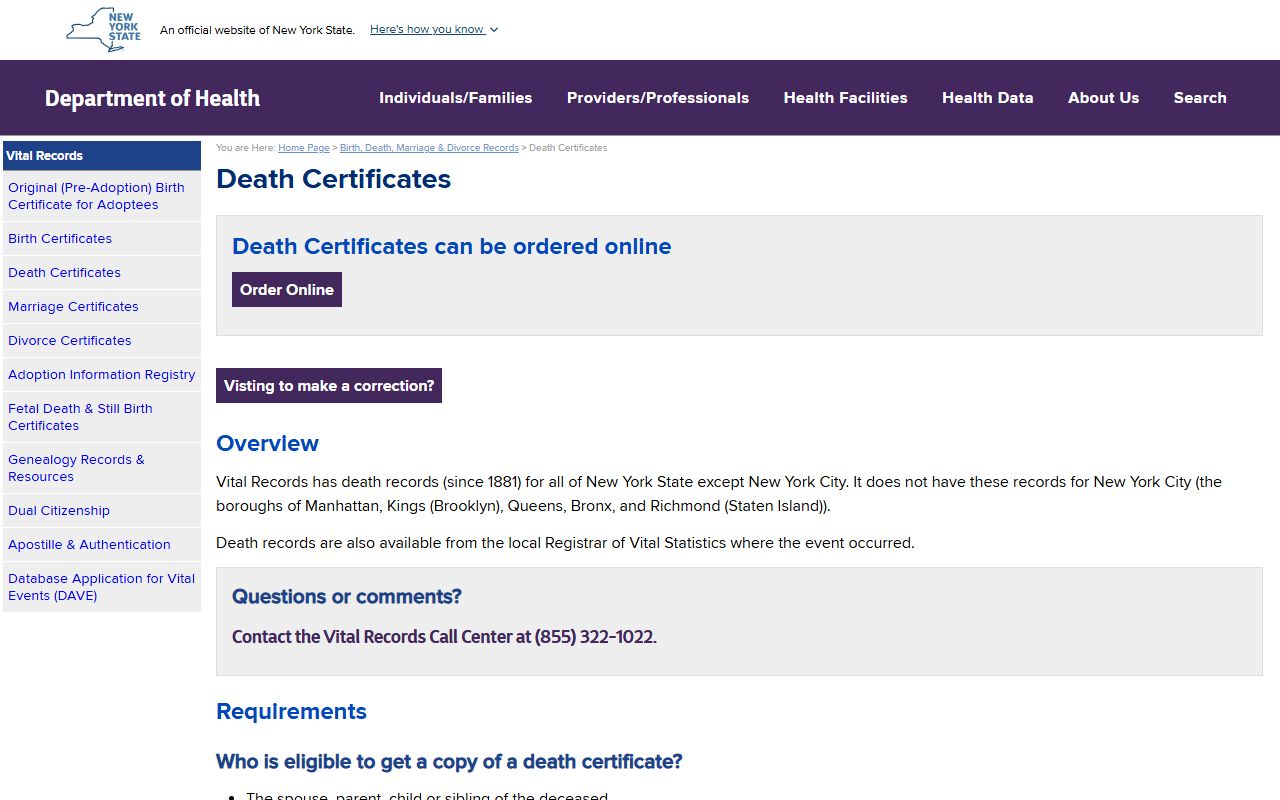
This page shows the current fees, ID requirements, and mailing address for death certificate orders that cover Albany County and the rest of New York State outside of NYC.
Nearby Counties and Cities
Albany County borders several other counties in the Capital District. Rensselaer County is just across the Hudson River to the east. Schenectady County sits to the west. Saratoga County is to the north, and Greene County is to the south. Schoharie County borders it to the southwest. Each of these counties has its own set of town clerks handling death records.
The City of Albany is the largest city in the county and the state capital. The Town of Colonie is also in Albany County and has its own page with death record details. If the death took place in a neighboring county, you will need to contact that county's local clerks or the state health department instead.